Solar LED lighting is moving beyond simple dusk-to-dawn operation. The key question is: how do intelligent power saving modes work in solar led lights? These systems monitor battery voltage, operating time, motion, and sometimes ambient conditions. They then adjust brightness automatically. A pathway light may provide full output when movement is detected, then reduce illumination to 20% during quiet periods. This saves stored energy without leaving the area completely dark.
The need is substantial. The International Energy Agency reported that global solar photovoltaic capacity additions reached about 375 gigawatts in 2023, showing how quickly solar technology is expanding. Meanwhile, the World Bank’s Lighting Global program has reported that off-grid solar products have reached hundreds of millions of people lacking reliable electricity. Efficient lighting matters in those settings. The U.S. Department of Energy notes that LED lamps generally use at least 75% less energy and last much longer than incandescent lamps.
As energy-efficiency researcher Dr. Evan Mills has observed, “The cleanest energy is the energy we do not need to use.” That principle fits intelligent solar lighting closely. A controller protects the battery by lowering output before deep discharge occurs. It can also reserve energy for the early morning hours. Small decisions matter.
Still, no algorithm is perfect. Heavy rain, dust on the panel, or an aging battery can confuse performance expectations. Manufacturers should publish measured runtime, dimming levels, battery capacity, and test conditions. Buyers should question impressive claims. Real-world reliability depends on careful design, not software alone.
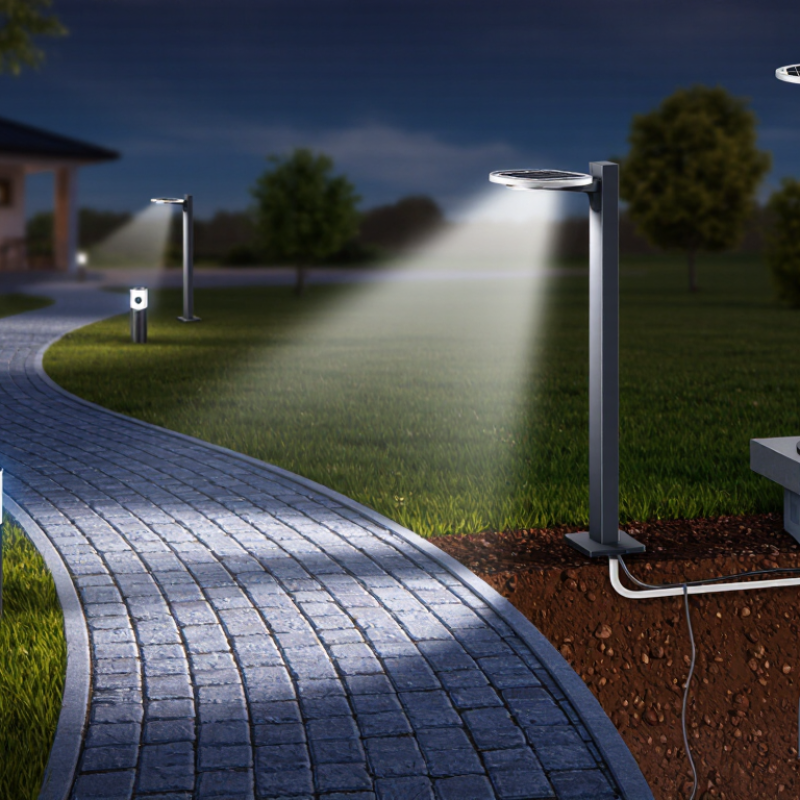
Intelligent power saving in solar LED lights means using energy only when illumination is needed. A controller reads motion, time, battery voltage, and sometimes weather data. It can maintain full brightness near a pathway, then reduce output after several quiet minutes. Brightness follows need, not habit.
This approach protects stored solar energy during long nights or cloudy periods. It can also reduce deep battery discharge, which may support longer battery service life. The IEA and UNEP Global Status Report for Buildings and Construction 2022 states that lighting uses about 15% of global electricity and creates nearly 5% of global greenhouse gas emissions. Solar lighting avoids grid consumption, but its battery remains limited. The U.S. Department of Energy reports that LED lighting uses at least 75% less energy than incandescent lighting and can last up to 25 times longer. Those figures are useful benchmarks, not promises for every solar fixture. A cloudy week can expose weak assumptions.
Tips: Set motion sensitivity after observing the site at night. Keep standby brightness modest, such as 20% to 30%, when safety allows. Check battery voltage and lighting hours monthly. If dimming feels too aggressive, raise the minimum brightness slightly. Intelligent control is not flawless. Dust, shade, poor sensor placement, and cold weather can still reduce performance. A simple usage log often reveals more than a complicated dashboard.
| Power-Saving Dimension | How It Works | Typical Setting or Behavior | Energy-Saving Benefit | Practical Consideration |
|---|---|---|---|---|
| Dusk-to-Dawn Detection | A light sensor or solar-panel voltage detects declining daylight and switches the LED on automatically after sunset. | The light operates only when ambient light falls below a programmed threshold. | Prevents daytime operation and avoids unnecessary battery discharge. | The threshold should be adjusted to reduce false activation caused by nearby lighting or reflections. |
| Scheduled Dimming | The controller lowers LED output during periods when fewer people or vehicles are expected. | A common profile is full output for the first 4–5 hours, followed by reduced output until dawn. | Reducing brightness from 100% to 50% approximately halves LED power consumption during that period, subject to driver efficiency. | The schedule should reflect local traffic patterns and required lighting levels. |
| Motion-Based Lighting | A motion or presence sensor raises the LED output when pedestrians, cyclists, or vehicles are detected. | The light remains at a low standby level and temporarily increases for a configurable period, often 30–120 seconds. | It reduces full-power operating time in low-traffic areas while preserving visibility when activity occurs. | Sensor range, mounting height, temperature, and false triggers can affect performance. |
| Battery State-of-Charge Protection | The charge controller monitors battery voltage or estimated state of charge and reduces output when stored energy is low. | Low-battery dimming or staged shutdown is activated before the battery reaches a damaging discharge level. | Extends battery service life and reserves energy for essential nighttime illumination. | Voltage thresholds vary with battery chemistry, temperature, load, and controller design. |
| Adaptive Night-Length Control | The controller estimates the available night period from dusk, dawn, a real-time clock, or stored operating history. | Brightness can be distributed across the expected night rather than using the same fixed runtime every day. | Helps prevent early shutdown after long winter nights and avoids excessive energy use during shorter nights. | Seasonal accuracy improves when the controller uses accurate time or location-based settings. |
| Weather-Aware Energy Management | Recent charging performance and battery condition are used to adjust the next night’s lighting profile. | After several cloudy days, the system may use a lower brightness level or prioritize later operating hours. | Improves the likelihood of maintaining light throughout the night when solar input is reduced. | This function requires reliable battery monitoring and a suitable control algorithm; it cannot create energy that was not harvested. |
| LED Current Regulation | A constant-current driver regulates the current supplied to the LEDs and supports multiple brightness levels. | Output is controlled through current adjustment or pulse-width modulation rather than simply switching the LED on and off. | Provides predictable light output and avoids wasting energy through unsuitable operating current. | Driver efficiency, thermal management, and LED operating temperature influence actual energy use. |
| Solar Charging Optimization | The charge controller regulates solar-panel power to charge the battery safely and efficiently. | Depending on the system design, PWM or MPPT charging may be used with overcharge and reverse-current protection. | Maximizes usable harvested energy while protecting the battery from charging faults. | Panel orientation, shading, dust, temperature, and seasonal sunlight strongly affect charging performance. |
| Emergency Energy Reserve | The controller reserves part of the stored energy for the later hours of the night or for essential low-level lighting. | The system may reduce brightness progressively instead of allowing the battery to reach complete depletion. | Improves nighttime availability after cloudy or rainy days. | A reserve strategy may lower brightness earlier, so the lighting target must be defined in advance. |
| Performance Monitoring | The controller records or communicates charging voltage, battery condition, LED runtime, and fault status. | Maintenance teams can identify low charging, excessive discharge, sensor faults, or abnormal energy consumption. | Early fault detection prevents prolonged energy waste and helps maintain expected lighting performance. | Monitoring data should be interpreted together with weather, shading, dust, and seasonal conditions. |
It matches brightness with real nighttime demand. The light may run at full output after sunset, then dim when the area becomes empty.
It monitors panel voltage and current. Maximum power point tracking can collect more energy during cloudy mornings or partial shade.
It can reserve energy through adaptive dimming. For example, the fixture may use full brightness for four hours, then reduce output before dawn. Not always perfectly.
A sensor can keep the lamp at 30% output while the pathway is empty. When movement appears, brightness may rise to 100% for 30 seconds.
It estimates charge level, temperature, and discharge depth. The controller can lower brightness after midnight, when pedestrian activity often decreases.
They should check sensor height, detection range, delay time, panel shadows, and battery condition. Poor adjustment can create dark spots or unnecessary switching.
Dusty panels, seasonal shadows, weak batteries, and incorrect calibration can waste stored energy. Advanced electronics cannot fix every installation problem.
No. It may drain the battery before dawn. Aggressive dimming can also reduce perceived safety. The balance needs testing.
Record overnight runtime across different seasons. Compare brightness, battery reserves, weather, and movement patterns. Laboratory results may look better than real streets.
Intelligent power saving in solar LED lights is the process of using stored energy more efficiently while maintaining useful illumination. These systems monitor factors such as battery level, solar charging conditions, ambient brightness, movement, time, and weather-related changes. By combining this information, the light can adjust its operation instead of running at full power continuously. The goal is to extend nighttime lighting, improve reliability, and reduce unnecessary energy consumption.
So, how do intelligent power saving modes work in solar led lights? They use control systems to select suitable lighting levels and operating schedules. For example, a light may remain dim when no activity is detected, increase brightness when motion occurs, and return to a lower setting afterward. Other functions may include dusk-to-dawn operation, timed dimming, low-battery protection, and adaptive brightness adjustment. These technologies can prolong battery life and provide more consistent performance, but their effectiveness depends on sunlight availability, sensor accuracy, battery condition, and local environmental conditions.

 Zeteo Light