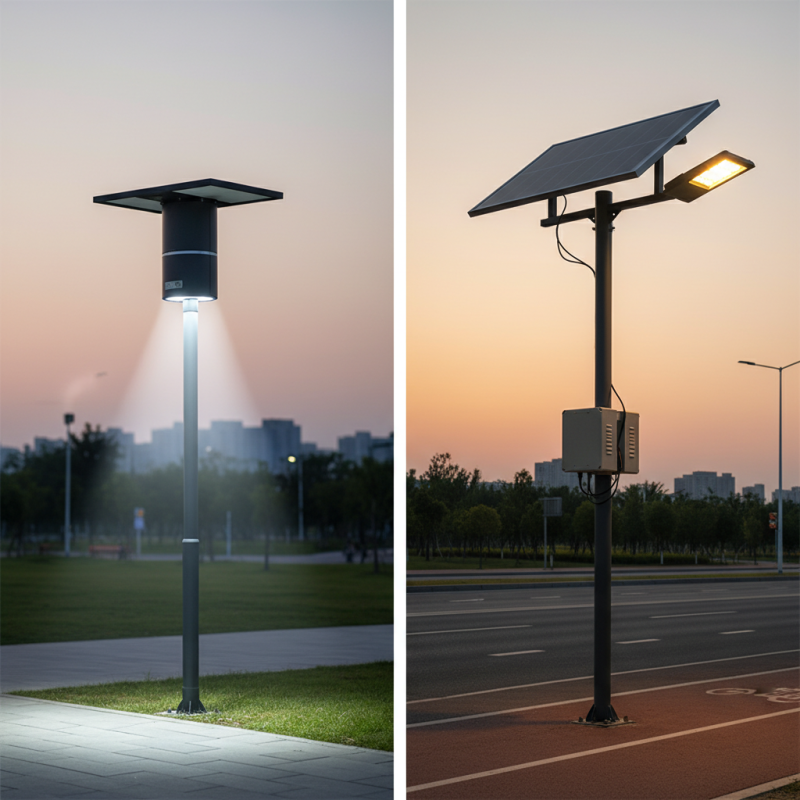
When considering outdoor lighting solutions, many ask, "what is the difference between integrated and split solar street lights?" According to Dr. Emily Tran, a leading expert in solar energy systems, "The main distinction lies in their design and efficiency." Integrated solar street lights combine the solar panel, battery, and LED in one unit, ensuring a compact and aesthetically pleasing look. On the other hand, split solar street lights separate these components, allowing for greater customization and efficiency, but often at the cost of simplicity.
This differentiation matters significantly for urban planners and property developers. Integrated lights save installation time and space, making them ideal for tight areas. However, they risk limited battery capacity due to size constraints. In contrast, split models can have larger batteries and panels, accommodating higher energy needs, yet they might require extensive installation efforts.
Understanding these differences can lead to better lighting choices. Each design has its pros and cons, and selecting the right one involves assessing the specific project requirements. As urban areas expand, the demand for effective and efficient street lighting continues to grow. Making informed decisions is crucial to meet these demands.
Understanding Integrated Solar Street Lights
Integrated solar street lights are an innovative solution for outdoor lighting. They combine solar panels, batteries, and LED lights into one compact unit. This design simplifies installation and maintenance. Additionally, these lights offer energy efficiency and cost savings over time. However, their integrated nature can pose challenges in repairs. If one component fails, it may necessitate the replacement of the entire unit.
Moreover, integrated solar street lights rely heavily on sunlight. In areas with limited sunlight, their performance may diminish. This reliance raises questions about their reliability during inclement weather. While manufacturers advocate for their effectiveness, real-world performance can vary significantly. It's worth considering local climate conditions and urban designs before installation.
The sleek design of integrated solar lights often appeals to modern aesthetics. They blend seamlessly into urban landscapes. However, functionality must be prioritized over appearance. Understanding the trade-offs is crucial for selecting the best option. Proper evaluation of street placement and solar orientation is essential for maximizing light performance. These factors can ultimately influence the effectiveness of integrated solar street lights.
Key Features of Split Solar Street Lights
Split solar street lights are gaining popularity for their unique features. They typically consist of separate components—a solar panel, a battery, and an LED light fixture. This design allows for flexible installation. According to a recent report from the International Renewable Energy Agency (IRENA), split models can increase energy efficiency by 30% compared to integrated alternatives. This efficiency is crucial in urban areas with increasing energy demands.
One notable aspect of split solar street lights is their ease of maintenance. Repairing or replacing parts is simply a matter of accessing the individual components. This can reduce downtime. A study by the Solar Energy Industries Association (SEIA) noted that maintenance costs for split systems can be up to 40% lower than for integrated systems. In regions with harsh weather conditions, the ability to replace components easily makes split lights particularly appealing.
Despite these advantages, split solar street lights may face installation challenges. The need for careful placement of solar panels is important for optimal sunlight exposure. Additionally, some users report difficulties with wiring and connections. The design may not suit every environment, particularly in densely packed urban spaces. These considerations can complicate decisions for municipalities. They highlight the importance of assessing specific needs before making a choice.
Energy Efficiency Comparisons: Integrated vs Split
Integrated and split solar street lights offer distinct energy efficiencies. Integrated lights combine solar panels, batteries, and LED fixtures into one unit. This design allows for a compact form, making installation easier and maintenance simpler. The all-in-one structure often results in lower initial costs. However, when a component fails, the entire unit may need replacement.
Split solar street lights separate components. The solar panel is mounted in a higher location, optimizing sun exposure. Meanwhile, batteries and LEDs can be placed less conspicuously. This separation can lead to greater energy efficiency, especially in environments with varying sunlight conditions. Also, repairs to individual parts are often more straightforward, potentially reducing long-term costs.
Tips: When assessing which system to choose, consider the local climate. If your area experiences heavy shading, split systems may retain efficiency longer. Pay attention to battery quality as well; superior batteries can dramatically impact performance. Always examine installation options, as they can sway energy outputs significantly. Opting for the right type can enhance the lifespan and efficiency of your street lights.
10 Key Differences Between Integrated and Split Solar Street Lights
| Feature |
Integrated Solar Street Lights |
Split Solar Street Lights |
| Design |
Compact and sleek design |
Bulky design with separate components |
| Installation |
Easier to install, usually pole-mounted |
Requires assembly of separate parts |
| Maintenance |
Less maintenance due to fewer parts |
Higher maintenance due to multiple components |
| Efficiency |
Optimized for battery and light integration |
Can use larger batteries and panels |
| Aesthetic Appeal |
Sleek appearance, blends easily |
More noticeable due to size and bulk |
| Cost |
Generally less expensive |
Higher initial investment |
| Light Output |
Typically lower brightness |
Can achieve higher brightness |
| Flexibility |
Limited flexibility in placement |
More flexible in installation location |
| Suitable Locations |
Urban and residential areas |
Rural and industrial areas |
| Lifespan |
Typically shorter lifespan due to compact batteries |
Longer lifespan with replaceable parts |
Installation and Maintenance Differences
When considering installation differences between integrated and split solar street lights, several factors stand out. Integrated models combine solar panels, batteries, and LED lights into one unit. This design makes installation straightforward. You only need to mount the unit on a pole. Generally, these lights require less time and effort to set up, making them ideal for quick deployment in smaller areas.
On the other hand, split solar street lights consist of separate components. You need to install the solar panel, battery, and light fixture individually. This can demand more complex installation skills and tools. However, it allows for greater flexibility in positioning. You can mount the solar panel in a location with optimal sunlight. Installation may take longer, and misalignment could result in reduced efficiency.
Maintenance also differs significantly. Integrated lights may need less frequent servicing due to their compact nature. However, if one component fails, you usually have to replace the entire unit. This can be costly. Split systems, while requiring more maintenance, allow for repairs on individual parts. This can save time and money in the long run. Yet, managing multiple components can lead to more chances for issues to arise. Balancing these factors is crucial for anyone considering solar street light options.
Cost Analysis: Integrated versus Split Solar Street Lighting
When analyzing the cost of solar street lights, integrated and split models present notable differences. Integrated solar street lights typically feature all components within a single unit. This compact design can reduce installation costs. On the other hand, split solar street lights have separate solar panels and lights, allowing for more flexible placement. Though they may have higher installation costs, their modularity can lead to lower maintenance expenses in the long run.
Tips: Consider the operational environment. In areas with frequent shade, split models may perform better. They allow the solar panel to be placed in more optimal locations. Evaluate long-term savings on energy costs when choosing between them.
Installation costs can vary significantly based on local labor rates. Integrated lights may require less labor time due to their simplicity. However, split lights might allow for easier repairs, as users can replace specific components without replacing the whole unit. Reflect on how the choice affects your budget and project timeline. Always remember that the initial investment can lead to recurring savings in maintenance and energy use.
FAQS
: Integrated solar street lights combine solar panels, batteries, and LED lights into one unit for outdoor lighting.
They simplify installation, reduce maintenance, and offer energy efficiency over time.
If one component fails, the entire unit may need replacement, which can be costly.
These lights rely heavily on sunlight. Limited sun can reduce their efficiency, especially in poor weather.
Local climate conditions and shading are crucial for maximizing light performance.
Integrated lights are all-in-one units, while split lights separate components for better sun exposure.
Integrated lights may have lower installation costs, but split lights can be more cost-effective for repairs.
Higher quality batteries can dramatically impact the efficiency and lifespan of solar street lights.
Proper placement of panels and lights can influence energy output and lighting effectiveness.
Assessing street placement and surrounding structures is essential for ensuring optimal light performance.
Conclusion
The article "10 Key Differences Between Integrated and Split Solar Street Lights" explores the distinctions between these two common types of solar lighting solutions. Integrated solar street lights feature all components, including the solar panel, battery, and LED light, consolidated into a single unit, allowing for easier installation and a streamlined design. In contrast, split solar street lights separate these components, which can provide flexibility in placement and potentially enhance energy efficiency through optimized solar panel positioning.
The article highlights critical aspects such as energy efficiency comparisons, where integrated models might offer compact efficiency, while split designs can maximize sunlight exposure. Additionally, it addresses the differences in installation and maintenance, emphasizing the often simpler setup of integrated lights versus the potentially more involved process for split lights. Finally, a cost analysis shows varying price points for both types, allowing users to make informed decisions based on budget and requirements. Overall, understanding "what is the difference between integrated and split solar street lights" aids in selecting the best option for specific lighting needs.

 Zeteo Light