China’s solar street-light market offers two dominant designs: integrated and split systems. For buyers, the question is not simply which model looks modern. It is what is the difference between integrated and split solar street lights, and how does that difference affect real streets?
An integrated light combines the panel, battery, controller, and LED unit inside one housing. Installation is faster, and the compact body suits village roads, parks, and temporary projects. However, its small panel area can limit charging during cloudy weeks. Battery heat may also shorten service life. The housing looks clean. That does not guarantee stronger performance.
A split system separates the solar panel from the lamp and battery. Installers can place the panel above trees, adjust its angle, and choose a larger battery. This design often performs better on shaded roads or during long winter nights. It requires more brackets, wiring, and maintenance. One loose cable can stop the entire fixture.
Solar-lighting engineer Steven Strong has emphasized a practical principle: “Good solar design starts with the site, not the product.” This advice matters when comparing China’s top suppliers. A product catalog cannot show local shading, dust, rainfall, or nighttime traffic. Field experience reveals those details.
This comparison will examine lighting output, battery chemistry, panel size, installation difficulty, durability, and after-sales support. Some conclusions may remain uncomfortable. The cheapest integrated lamp is not always economical. The largest split system is not automatically better. Site conditions decide more than marketing claims.
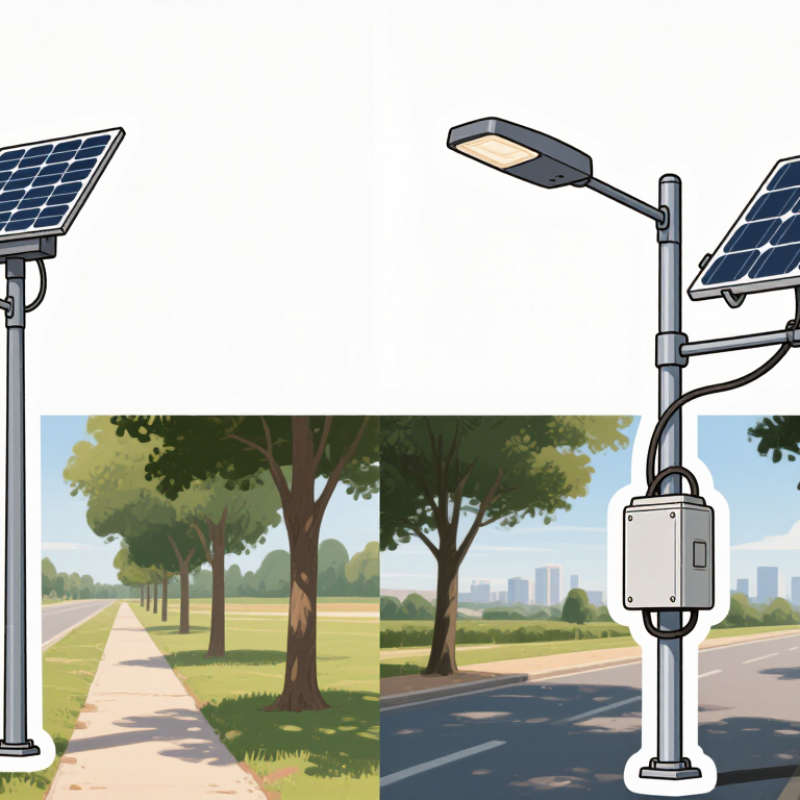
Integrated solar street lights place the photovoltaic panel, battery, controller, and LED lamp in one housing. Their compact structure simplifies transport and installation. A technician can mount the unit on a suitable pole with fewer cable connections. This reduces installation time and possible wiring errors.
Split solar street lights use separate components. The panel sits above the lamp, while the battery and controller remain in another enclosure. This layout allows better panel orientation and larger battery capacity. It works well near tall buildings, trees, or roads needing longer lighting periods. However, installers must protect external cables from water, vibration, and accidental damage.
In field assessments, integrated models perform well on open roads with reliable sunlight. Their sealed design can reduce maintenance points. Yet heat buildup inside a compact housing may affect battery life in very hot regions. Split systems offer easier component replacement, but they need stronger brackets and careful alignment. Neither design wins every site. That choice is often harder than the brochure suggests.
Before selection, engineers should check daily sunlight, pole height, wind exposure, drainage, and nighttime traffic. Battery capacity should match cloudy-day requirements, not only clear-weather performance. Installation crews should verify waterproof ratings and follow local electrical and structural standards. A small shadow can change charging results. Real conditions matter more than attractive specifications.
What Are Integrated and Split Solar Street Lights?
| No. | Evaluation Dimension | Integrated Solar Street Light | Split Solar Street Light | Recommended Choice |
|---|---|---|---|---|
| 1 | Basic Configuration | The solar panel, battery, LED lamp, controller, and housing are combined into one compact unit. | The solar panel, battery, controller, and LED lamp are installed as separate components connected by cables. | Depends on site |
| 2 | Typical Installation Time | Usually faster because the main components are factory-assembled and require fewer field connections. | Usually takes longer because the panel, battery enclosure, controller, and lamp require separate mounting and wiring. | Integrated |
| 3 | Solar Panel Size | Common commercial designs generally use a smaller panel area because the panel is limited by the lamp housing. | The panel can be sized independently, making larger photovoltaic capacity easier to achieve. | Split |
| 4 | Battery Capacity and Autonomy | Battery capacity is constrained by the available housing space. Many products use lithium-based batteries, often LiFePO4. | A larger or separately housed battery can be selected for longer backup periods and higher lighting loads. | Split |
| 5 | Lighting Power Range | Commonly suited to compact applications, often approximately 20–80 W of LED power, depending on design and lighting requirements. | More suitable for higher-output systems because the solar panel and battery can be increased independently. | Split |
| 6 | Shading Tolerance | Performance can be strongly affected when the lamp-mounted panel is shaded by trees, buildings, or nearby structures. | The panel can be installed in a more open location and positioned for better solar exposure while the lamp remains over the road. | Split |
| 7 | Maintenance and Replacement | Fewer external cables and components simplify routine inspection, but a single integrated assembly may need to be removed for some repairs. | Individual components can usually be serviced or replaced separately, although there are more cables and connection points to inspect. | Split |
| 8 | Security and Theft Risk | The compact design has fewer exposed cables and separate enclosures, which can reduce tampering opportunities. | Separate batteries and cables may require locked enclosures, protected conduit, and anti-theft fasteners. | Integrated |
| 9 | Pole and Structural Load | The combined unit is generally compact, but its weight and wind area remain important when selecting the pole and mounting bracket. | The separated panel can have a larger wind area and may require stronger brackets, especially in areas with high wind loads. | Integrated |
| 10 | Best Application | Suitable for residential roads, parks, pathways, small parking areas, temporary projects, and locations where simple installation is important. | Suitable for highways, wide roads, high-latitude locations, shaded sites, high-traffic areas, and projects requiring greater design flexibility. | Site-specific |
Integrated lights combine the panel, battery, controller, and LED module. They install quickly. Split systems use separate components and allow better panel positioning. They also simplify battery replacement.
They suit parks, village roads, pedestrian paths, and small parking areas. Their compact housing reduces cable damage risks. However, limited internal space may reduce battery capacity and heat dissipation.
Choose a split system for wide roads, highways, shaded streets, or weak winter sunlight. Its adjustable panel can improve charging. Separate components also make maintenance easier.
Measure sunlight, pole spacing, traffic levels, winter temperatures, and required night-time runtime. A shaded lane may need a split design. An open path may need less complexity.
Winter brings shorter charging periods and weaker sunlight. A small battery may stop lighting before dawn. Three nights of autonomy is a practical target. Still, local weather can make this estimate imperfect.
Request charging records, battery cycle data, lighting curves, and installation drawings. Waterproofing, thermal behavior, and dimming schedules should also be tested. Independent reports are more convincing than attractive samples.
Look for IP65 or higher protection ratings. Verify the rating through independent documentation. Coastal projects also need salt-spray testing. Northern projects need low-temperature battery testing.
No. Factory size does not guarantee reliable operation after installation. Request a pilot installation with measured lux levels, charging records, and night-time runtime. A polished sample may still hide practical weaknesses.
Incorrect panel angles, loose wiring, and poor pole placement can reduce charging and lighting. Installation matters greatly. Sometimes, it matters more than the lamp design. Spare parts and remote support should be confirmed before ordering.
This guide explains the fundamentals of integrated and split solar street lights, including their main components, operating principles, and typical installation methods. Integrated models combine the solar panel, battery, LED light, and controller in one compact housing, while split designs place these components in separate positions. Understanding how each system captures solar energy, stores power, and provides nighttime lighting helps readers compare their suitability for different roads, climates, and project requirements.
A central question is: what is the difference between integrated and split solar street lights? The answer involves structure, installation flexibility, maintenance, lighting performance, and space requirements. The guide also introduces ten leading types of manufacturers in China by focusing on industry capabilities rather than brand promotion. Finally, it offers practical advice for choosing between the two designs according to sunlight conditions, available installation space, lighting demand, budget, battery capacity, and long-term maintenance needs.

 Zeteo Light