China’s top LED street lights are designed for long service, yet many roads slowly lose brightness. If you are asking, “why are my led street lamps turning dim over time,” the answer is rarely one simple fault. LED chips naturally experience lumen depreciation. Their drivers can also weaken, especially after years of heat, voltage variation, and continuous nighttime operation.
James R. Brodrick, a former U.S. Department of Energy solid-state lighting manager, has explained: “LEDs do not burn out; they depreciate in light output.” That sentence is useful, but it does not tell the whole story. A lamp may appear dim because its LED module aged, or because its optical cover became cloudy. Dust can settle on the lens. Coastal salt can leave a thin, dull film. Inside the housing, dried thermal compound may reduce heat transfer from the chip to the heat sink.
The driver deserves equal attention. Swollen capacitors, unstable current, and loose connections can reduce output before the LEDs reach their rated life. A technician should measure illuminance at ground level, inspect the lens, and compare current readings with the original specification. Replacing the entire fixture may be unnecessary. Sometimes cleaning or changing the driver restores performance.
Still, product quality matters. Reliable manufacturers publish LM-80 testing, TM-21 projections, surge protection data, and operating-temperature limits. Marketing claims alone are not enough. I have seen fixtures rated for 100,000 hours perform poorly when installed in sealed housings under intense summer heat. That contradiction deserves honest review, not easy blame.
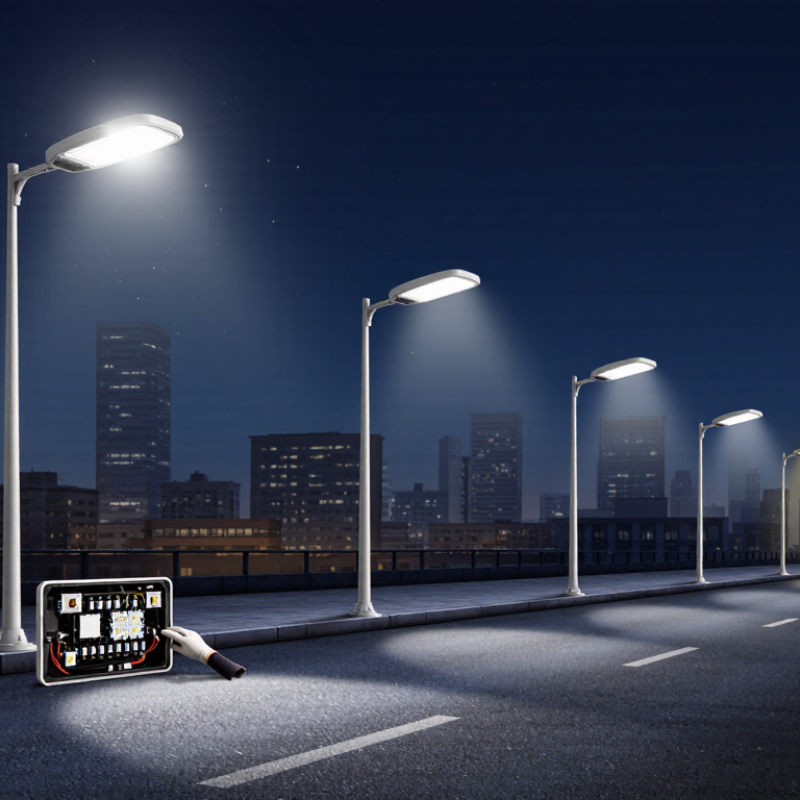
LED street lights rarely fail suddenly. Their light output usually decreases gradually as chips age, lenses discolor, and drivers lose efficiency. L70 describes the estimated time when a luminaire produces 70% of its initial light output. A 100,000-hour L70 rating does not mean the fixture stops working then. It means the light may become noticeably weaker.
This rating comes from laboratory testing and modeling, often using LM-80 data and TM-21 projections. Real streets are less controlled. High housing temperatures, poor ventilation, voltage variation, dust, moisture, and frequent switching can accelerate depreciation. Thermal management matters greatly. A fixture operating beside hot asphalt may age faster than one tested indoors. The first specification is not always the full story.
Tips: Check the rated ambient temperature, measured lumen maintenance, driver warranty, and test conditions. Request maintenance data, not only a large lifetime number. Clean lenses periodically and inspect mounting surfaces for blocked airflow. Photometric testing can reveal gradual losses before roads look visibly dark.
In practice, a reliable assessment compares initial and current illuminance at the pavement. It also checks uniformity, glare, and dark spots. L70 alone cannot describe every field result. I think this is where many purchasing decisions become too optimistic. A longer projected life may still deliver poor lighting if heat control or maintenance is neglected. Steady monitoring gives operators better evidence than impressive claims.
China Top LED Street Lights: Why Do They Dim Over Time?
Street lights rarely become dim overnight. Their light output usually declines through heat, electrical stress, and material aging. IES LM-80-21 requires at least 6,000 hours of LED performance data. Testing typically records lumen output at regular intervals, often every 1,000 hours. The data should include operating temperature and drive current. Without these conditions, a lumen figure is difficult to trust.
Six thousand hours equals about 250 days. That is useful evidence, but it is not a complete lifetime guarantee. The U.S. Department of Energy’s LED performance reports emphasize thermal management as a major factor in long-term reliability. A hot LED board can accelerate phosphor aging and reduce light output. Dirty lenses and blocked airflow make the problem worse. In real streets, dust, summer heat, and voltage variation rarely behave like laboratory conditions.
LM-80 data describes LED components, not an entire street-light fixture. TM-21 calculations use LM-80 results to estimate future lumen maintenance, but projections still depend on test quality. A fixture rated for 100,000 hours may therefore require closer inspection. Ask for the original test records, temperature points, current settings, and projected L70 value. The uncomfortable truth is simple: many purchasing decisions focus on the first-year brightness, not the tenth-year performance. That deserves reconsideration.
| Performance Dimension | Verified Test Requirement or Indicator | How Dimming Develops | Interpretation for LED Street Lights |
|---|---|---|---|
| LM-80 test duration | At least 6,000 hours of LED light-output and color-maintenance data. | LED output is monitored over time instead of being judged only from initial brightness. | A 6,000-hour LM-80 report demonstrates measured LED performance, but it is not a guarantee that the complete luminaire will remain at its initial output indefinitely. |
| Measurement interval | Measurements are taken at regular intervals, normally no greater than 1,000 operating hours. | Periodic readings reveal gradual lumen depreciation and possible changes in chromaticity. | A continuous performance trend is more useful than a single initial-lumen value when comparing long-term reliability. |
| Test temperature | Standard LM-80 evaluations commonly include case temperatures of 55°C and 85°C, plus a manufacturer-selected temperature. | Higher LED case temperature accelerates material degradation and can reduce lumen maintenance. | The test temperature should be compared with the actual thermal conditions inside the street-light housing. |
| Thermal management | Relevant indicators include LED case temperature, heat-sink design, thermal interface quality, and housing airflow. | Blocked vents, undersized heat sinks, dirt buildup, and poor thermal contact increase operating temperature. | Effective heat dissipation helps slow lumen depreciation and protects the LED driver and electronic components. |
| Driver aging | The LED driver should be evaluated separately for output-current stability, temperature capability, and service life. | Capacitor aging, electrical stress, surge events, and unstable current can lower system light output even when the LED package remains functional. | LM-80 applies to LED packages, modules, or arrays; it does not by itself qualify the complete driver or luminaire. |
| Lumen maintenance | Lumen maintenance is expressed as the percentage of measured light output remaining compared with the initial value. | Phosphor degradation, elevated temperature, current stress, and optical contamination reduce delivered lumens. | For a complete street light, system lumen maintenance also depends on optics, driver performance, seals, and environmental exposure. |
| TM-21 projection | TM-21 uses LM-80 measurement data to project long-term lumen maintenance under defined conditions. | The projection is based on tested data and specified calculation limits; it is not the same as directly measuring the lamp for the projected period. | Long-life claims should identify the LM-80 data set, test temperature, drive current, and the conditions used for the projection. |
| Outdoor environment | Important field conditions include ambient temperature, humidity, dust, vibration, voltage surges, and water ingress protection. | Outdoor contamination and electrical or moisture damage can reduce light output faster than laboratory LED data suggests. | A reliable evaluation must combine LM-80 LED data with complete-luminaire testing and suitable installation and maintenance conditions. |
| Recommended evidence | Request the LM-80 report, TM-21 calculation, in-situ temperature data, driver specifications, and complete-luminaire photometric results. | Using only initial lumens or a marketing life figure can conceal thermal, driver, and environmental limitations. | The most dependable comparison uses measured data that matches the intended LED current, operating temperature, optics, and street-light application. |
China’s top LED street lights can dim when heat remains trapped inside the housing. The critical point is the LED junction, not only the outside temperature. Above 85°C, phosphor aging, semiconductor degradation, and lumen depreciation accelerate noticeably.
The U.S. Department of Energy reports that LED lifetime depends mainly on lumen maintenance, not sudden failure. Its LED Lighting Facts guidance commonly evaluates performance toward 70% initial lumens, known as L70. IES LM-80-21 requires at least 6,000 hours of LED package testing, while 10,000 hours provides stronger evidence. These tests use controlled temperatures, but real streets add dust, solar heat, blocked vents, and cycling.
In field inspections, a sealed luminaire may show a cool metal surface while its junction remains much hotter. That difference can exceed expectations. For example, a 40°C summer night with poor thermal contact may push the junction beyond 85°C. Every extra thermal path matters: solder quality, interface material, fin spacing, and driver placement. The IES TM-21 method can project lumen maintenance, but projections remain limited by test duration and operating conditions. A 50,000-hour claim therefore deserves careful review, especially when the tested temperature differs from the installed environment.
My own assessment is imperfect without junction-temperature measurements. Infrared images alone cannot prove the internal temperature. Designers should combine thermocouples, thermal simulation, LM-80 data, and long-term field records before predicting dimming.
China’s top LED street lights can dim over time, but the LED chip is not always the main suspect. In field inspections, the driver often shows the earliest signs of stress. Its electrolytic capacitors lose capacity after years of heat, current, and daily thermal cycling. As ripple increases, the output current becomes less stable. Light may appear weak, uneven, or slow to start. The diagnosis is not always neat.
Surge damage creates another hidden failure path. Lightning-induced transients and grid switching can pass through a weakened surge protector. A driver may continue working while its power components slowly degrade. This partial damage is easy to miss during a daytime check. Night testing should include input voltage, output current, power factor, and flicker. Technicians should also inspect burnt terminals, swollen capacitors, cracked seals, and water traces. A lux reading alone cannot prove LED chip failure.
Good maintenance records make the cause easier to verify. Compare the same fixture’s initial current with its present reading, then check nearby fixtures under similar load. Loose connections, poor heat transfer, and moisture can accelerate driver aging. Replacing only the LED module may waste time if the driver remains unstable. I have sometimes blamed the chip too quickly. That mistake deserves correction. A controlled driver test, thermal inspection, and surge-protection check provide stronger evidence than appearance. Different roads may need different service intervals.
China Top LED Street Lights: Why Do They Dim Over Time?
An LED street light rarely dims from one cause. Dust settles on the lens, reflector, and heat sink. In coastal areas, salt moisture creates a thin, light-scattering film. The CIE 154:2003 guidance on outdoor lighting maintenance identifies luminaire dirt depreciation as a key maintenance factor. Depending on traffic, dust, and cleaning schedules, optical losses can reach roughly 10–30%. That range is practical, not universal.
Moisture causes trouble in quieter ways. Repeated heating and cooling can draw humid air through seals. Condensation may then corrode contacts or cloud optical surfaces. The U.S. Department of Energy’s LED luminaire reliability reports link thermal stress, driver failure, and environmental exposure to long-term performance. UV exposure also matters. Lens polymers can yellow, while gaskets become brittle. A yellowed lens absorbs and scatters part of the light before it reaches the road.
The datasheet is only one view. IES LM-80 measures LED package lumen maintenance, while IES TM-21 projects that data; neither fully represents a dirty outdoor luminaire. For example, an LED package may retain over 90% output in controlled testing, yet the installed fixture can perform worse. Field inspections should compare illuminance, lens clarity, seal condition, and temperature. A 10% maintenance factor may be too optimistic in dusty districts. Sometimes, even careful engineers discover that cleaning records were missing.
Estimated normalized optical output over 10 years under different environmental conditions. Dust, moisture, and UV exposure reduce emitted light through optical blockage, material degradation, and accelerated lumen depreciation.
Output is indexed to 100% at installation. The clean and dry condition represents normal LED lumen depreciation, while the other scenarios show additional environmental losses. Actual results vary with luminaire sealing, road dust, humidity, UV exposure, cleaning frequency, and operating temperature.
Heat, electrical stress, dust, moisture, and aging materials gradually reduce light output. It is rarely sudden. The LED chip may not be the main cause.
LM-80 testing requires at least 6,000 hours of LED performance data. Measurements often occur every 1,000 hours. Records should include temperature and drive current.
No. Six thousand hours equals about 250 days, not a complete lifetime guarantee. Actual streets add dust, heat, voltage changes, and moisture.
Request original test records, temperature points, current settings, and the projected L70 value. Also ask how the projection was calculated. A large lifetime number alone proves little.
Yes. Driver capacitors can lose capacity after repeated heat exposure. Unstable current may create weak, uneven, or delayed light. The diagnosis can be messy.
Test input voltage, output current, power factor, and flicker at night. Inspect swollen capacitors, burnt terminals, cracked seals, and water traces. A daytime inspection may miss partial damage.
Dust can cover the lens, reflector, and heat sink. Salt moisture may leave a thin scattering film. Dirt-related optical losses can reach roughly 10–30%, depending on conditions.
Yes. Condensation may corrode contacts or cloud optical surfaces. UV exposure can yellow lenses and harden gaskets. Cleaning records are sometimes missing. That weakness deserves attention.
No. Component testing does not fully represent a dirty, aging luminaire. Field checks should compare illuminance, lens clarity, seals, and temperature. I may have trusted laboratory figures too quickly.
Not always. An unstable driver, loose connection, poor heat transfer, or moisture may remain. Compare current readings with nearby fixtures under similar loads. Replacing one part may waste time.
LED street lights do not usually become dim overnight; their output gradually declines through a process known as lumen depreciation. The L70 rating estimates how long a fixture may operate before producing 70% of its initial light, while LM-80 testing provides a minimum of 6,000 hours of LED performance data to help evaluate this decline. A major factor is thermal stress: when junction temperatures remain above 85°C, heat can accelerate material aging and reduce light output. This is why are my led street lamps turning dim over time a common question for street-light operators.
Dimming can also result from driver aging, electrical surges, and weakened power components rather than LED chip failure alone. In addition, dust on optical surfaces, moisture intrusion, and prolonged UV exposure can reduce transmission and damage protective materials. Effective heat management, reliable electrical protection, sealed construction, and regular cleaning can help slow these losses and extend the useful service life of LED street lighting.

Zeteo Light